
Psychological Safety in Agile Teams: The Research-Backed Driver of Real Performance
Google's Project Aristotle identified psychological safety as the #1 factor in high-performing teams. Here's what it is, how it breaks down in Scrum, and how to build it.
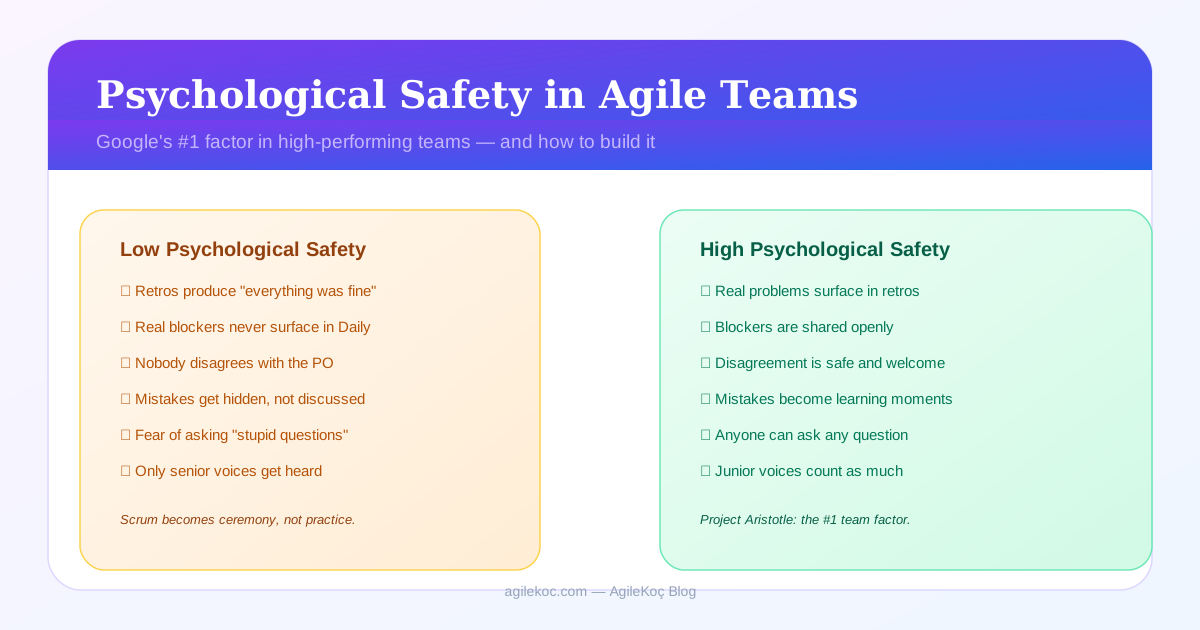
I've sat in Sprint Retrospectives where everyone said 'the sprint went fine' while three things had clearly gone wrong. The Scrum Master asked the question. The room went quiet. Someone said 'it was good overall.' Others nodded.
Nobody was lying. They were protecting themselves. In a room where surfacing problems feels risky, people stop surfacing them.
That's what low psychological safety looks like. And it quietly destroys Agile teams — not dramatically, but sprint by sprint, as the real conversations stop happening.
What Is Psychological Safety?
Psychological safety is a concept defined by Harvard Business School professor Amy Edmondson in 1999: 'A shared belief held by members of a team that the team is safe for interpersonal risk-taking.'
In plainer terms: You can ask a question without worrying it sounds stupid. You can flag a mistake without fearing punishment. You can disagree with your manager without it being a career risk.
An important distinction: psychological safety is not about everyone getting along or conflicts never happening. It's about the hard conversations being possible. A psychologically safe team doesn't avoid problems — it brings them to the surface.
What Google's Project Aristotle Found
Between 2012 and 2015, Google studied 180 of its own teams. The question was simple: what separates high-performing teams from the rest?
The expectation was that the best individuals would form the best teams. The research showed something else entirely: who was on the team mattered far less than how they worked together.
Five factors were identified. The first and most important: psychological safety. Without it, the other four — dependability, structure and clarity, meaning, and impact — didn't produce the expected results.
- 1. Psychological Safety: Is it safe to take risks? (most critical factor)
- 2. Dependability: Can team members count on each other?
- 3. Structure and Clarity: Are goals and roles clear?
- 4. Meaning: Does the work feel personally significant?
- 5. Impact: Does the team believe their work matters?
Why Psychological Safety Is Critical for Scrum
Scrum is built on transparency, inspection, and adaptation. All three require people to tell the truth. Psychological safety is what makes truth-telling possible.
Sprint Retrospective without psychological safety: 'Everything went fine. We should communicate better.' The same three items appear on the board every sprint. The actual problems are never named.
Daily Scrum without psychological safety: 'Still working on yesterday's task, no blockers.' The developer who's been blocked for three days says nothing because admitting it feels like admitting failure.
Sprint Review without psychological safety: The team shows the work, stakeholders applaud politely, real feedback never surfaces. Both sides performed. Neither side learned.
Signs of Low Psychological Safety
If several of these are true for your team, there may be a safety problem at the foundation:
- Retrospectives consistently produce 'it went well overall' with no real issues named
- Blockers rarely surface in Daily Scrum — everyone reports forward progress
- Nobody pushes back on the Product Owner's decisions
- Mistakes get hidden or attributed to others rather than acknowledged
- New ideas get dismissed with 'we've always done it this way'
- Junior team members are consistently silent in meetings
- Real problems only surface in hallway conversations, not in Scrum events
How strong is your Scrum foundation? Test your understanding of Scrum roles, events, and core principles in about 10 minutes with the Scrum Quiz.
The Unseen Game: Trust, Rhythm, Purpose
A practical mini-book using a football-club metaphor to reveal the invisible system behind performance: trust, alignment, roles, and team rhythm.
English edition
How Scrum Masters Build Psychological Safety
Psychological safety isn't built in a single team-building exercise or workshop. It's the long-term result of consistent, deliberate behavior — mostly from whoever holds the most influence in the room.
The highest-leverage behaviors:
- Turn mistakes into learning: Ask 'what did we learn from this?' instead of 'what went wrong?' The framing changes everything.
- Be vulnerable first: Share one of your own mistakes or gaps publicly. When a leader is vulnerable, the team learns it's safe to be vulnerable.
- Ask, don't judge: 'What made you think that?' builds understanding. 'That's wrong' closes conversation.
- Actively invite the quiet: 'Alex, what do you think about this?' Silence isn't absence of opinion — it's often unexpressed concern.
- Thank the bringer of bad news: 'I'm glad you flagged this early' is one of the most powerful phrases a Scrum Master can use.
- Normalize disagreement: 'Different views are valuable here — let's understand both' makes conflict feel productive, not threatening.
Psychological Safety in Retrospectives: Practical Techniques
The Sprint Retrospective is where psychological safety gets tested most directly. These techniques help surface what people actually think:
- Anonymous safety check-in: Before the retro, ask everyone to rate psychological safety 1-5 anonymously. Sharing the results creates awareness and opens conversation.
- Sailboat format: 'Wind' (what's helping) and 'anchors' (what's slowing us down) frames problems as systemic rather than personal.
- Pre-mortem: 'If the next sprint failed, what would have caused it?' separates thinking from blaming and surfaces real concerns safely.
- 1-2-4-All: Individuals write first, then pairs discuss, then groups of four, then the whole team. Quieter voices get heard before louder ones dominate.
- Written before verbal: Having everyone write thoughts before speaking reduces anchoring and gives introverts equal footing.
Amy Edmondson's Four Leader Behaviors
In 'The Fearless Organization' and her widely-watched TED talk, Amy Edmondson distilled decades of research into four core behaviors for building psychological safety:
- Frame the work: Position mistakes and uncertainty as learning opportunities, not failures
- Invite participation: Actively request everyone's input. Make 'does anyone see this differently?' a regular question
- Respond productively: When concerns are raised, take them seriously — don't minimize or dismiss
- Express appreciation: Greet mistakes, pushback, and bad news with genuine thanks for bringing them to light
Does Psychological Safety Conflict With High Performance?
The common objection: 'We're a results-driven team. Can we really afford to focus on this kind of thing?'
Google's research answers this directly: psychological safety and high performance are not opposites. Psychological safety is what enables sustained high performance.
A low-safety team can deliver results in the short term. But over time, mistakes get buried, real problems compound, and good people start leaving. The high performers who could have raised concerns didn't — because it wasn't safe to.
The research found that the highest-safety teams had both lower error rates and faster learning. Not because they made fewer mistakes, but because they surfaced them faster and fixed them before they grew.
Want to start this shift in your team? Whether you're diagnosing a safety problem, redesigning your retrospectives, or coaching a team through a cultural change — Scrum Master Coach can help you plan the approach and the conversations.
The Bottom Line
Psychological safety isn't a 'soft skills' topic. It's the operating condition that determines whether Scrum actually works.
You can optimize your velocity, refine your story point system, and run textbook ceremonies. But if people can't tell the truth — about blockers, mistakes, concerns, or disagreements — the three pillars of Scrum (transparency, inspection, adaptation) all quietly collapse.
The good news: psychological safety can be built. Not through a single initiative, but through the small, consistent choices made in every meeting, every retrospective, every moment when someone brings bad news. How do you respond? Does the person who flagged the problem feel glad they did?
If your retrospectives aren't surfacing real problems, if everyone reports forward motion in Daily Scrum, and if nobody ever disagrees with anyone — the issue isn't the process. It's the foundation. And foundations are rebuilt one behavior at a time.
Frequently Asked Questions
Is psychological safety the same as psychological comfort? No. Psychological safety means hard conversations are possible. Comfort means avoiding them. A safe team talks about difficult things; a comfortable team avoids them. Safety can coexist with high standards and accountability.
How long does it take to build psychological safety? It takes minutes to break and months to build. A single dismissive response to someone raising a concern can undo months of work. Consistency matters more than intensity.
What can a Scrum Master actually do? The highest-leverage thing is changing their own behavior. Asking instead of judging. Responding instead of minimizing. Sharing their own mistakes. Being publicly vulnerable. These behaviors, done consistently, shift team culture over time.
What if leadership doesn't support this? It's genuinely hard. A Scrum Master can build safety within their team while organizational safety remains low. Using data — Project Aristotle, Edmondson's research, retention metrics — to frame the conversation in business terms helps get leadership attention.
Where can I learn more about Amy Edmondson's work? 'The Fearless Organization' is the comprehensive starting point. For a shorter introduction, her TED talk 'Building a psychologically safe workplace' covers the essentials in 12 minutes and is widely shared in the Agile community.
Try the Related Tool
Define sprint friction, form hypotheses, design an experiment, and run follow-up loops.
Open coach agent->Make your Scrum Master impact visible + free PDF
Get short, practical tips each week. Your first email includes the “Scrum Master Impact Dashboard” PDF to help make your contribution visible.
SCRUM MASTER IMPACT DASHBOARD
30 Metrics + 6-Week Plan + Manager Conversation Guide
This document solves a common challenge for early/mid-level Scrum Masters: “How can my contribution be measured?” Without obsessing over velocity, without blame, you'll build a practical system focused on impact.
- Start in 10 minutes
- First results in 6 weeks
- Minimum set with 5 metrics
Golden rule: A Scrum Master doesn't “sell speed.” They improve learning and flow.
How to use this PDF
- 1) Pick 5 metrics today
- 2) Capture baseline (10 min)
- 3) Follow the 6-week plan
- 4) Update the dashboard each sprint
- 5) Talk to your manager with 3 sentences + 1 table
Minimum starter set
- Psychological safety
- WIP
- Sprint goal
- Unplanned work
- Blocker time
How do you prove your impact as a Scrum Master?
Without obsessing over velocity: 5 metrics + a 6-week plan for a clear impact story.
- 5-metric impact dashboard
- 6-week execution plan
- Manager-ready talk track
We respect your privacy. We only use your email to send the PDF and weekly tips.
No spam. Unsubscribe anytime.