
How to Receive Feedback Without Getting Defensive
A practical guide to receiving feedback well: why it triggers defensiveness, a 3-trigger framework, real scripts, common mistakes, and a 7-day practice challenge.
Giving feedback gets all the attention. Receiving it is harder.
Most feedback advice is written for the person giving it: use SBI, be specific, be kind. Almost nothing is written for the person on the other end, even though receiving feedback well is the harder skill.
Here is what actually happens in your body when someone says "Can I give you some feedback?": your heart rate goes up, your attention narrows, and you start preparing a defense before they finish the sentence. That is not a character flaw. It is a normal threat response, and it happens to competent, secure, high-performing people just as often as anyone else.
The good news: you can learn to receive feedback well without pretending it does not sting. This guide gives you the framework, the scripts, and a way to practice before the next hard conversation lands in your lap.
The three triggers that make feedback land badly
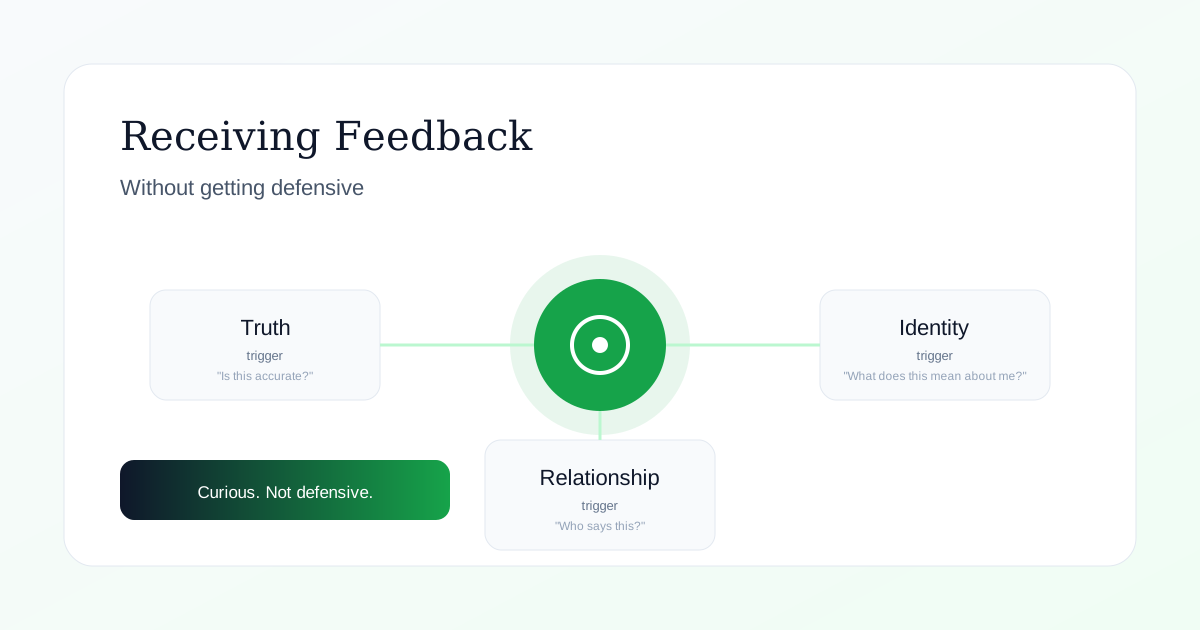
Research on receiving feedback (most notably Douglas Stone and Sheila Heen's Thanks for the Feedback) identifies three separate triggers that can fire the moment feedback arrives — often at the same time, which is why it feels overwhelming.
- Truth trigger: "That's not accurate" — you focus on what's wrong with the feedback itself.
- Relationship trigger: "Who are you to tell me this?" — the reaction is about the messenger, not the message.
- Identity trigger: "What does this mean about me?" — the feedback threatens how you see yourself.
Naming which trigger fired — even silently, in your head — is often enough to stop it from hijacking the conversation. "I notice I'm having an identity reaction right now" is a very different internal sentence than "this person is wrong about me."
A true story: the feedback that felt like an attack (but wasn't)
A backend engineer (call him Kaan) got this message from his tech lead: "Your last three PRs took way longer to review than they should have — too much scope in one branch." Kaan's first internal reaction was: She thinks I'm slow. She's building a case against me.
He almost replied defensively. Instead, he waited an hour, then asked: "Can you walk me through one of the PRs? I want to understand what specifically made review harder." It turned out the tech lead had zero concerns about his speed — she just wanted smaller, reviewable diffs so bugs surfaced earlier.
Nothing about Kaan's competence was ever in question. His identity trigger had invented a story that was not in the feedback at all. One clarifying question replaced a week of quiet resentment with a two-minute alignment.
What to say in the first 10 seconds
The first thing you say sets the entire tone of the conversation. Avoid these two extremes:
- Too defensive: "That's not really what happened" (shuts the conversation down before you've even heard it).
- Too passive: "You're totally right, I'm sorry" (agrees before you've actually understood, which teaches people to stop being specific with you).
The middle path — curious, not defensive, not instantly agreeable: "Thanks for bringing this up. Can you give me a specific example so I understand exactly what you mean?" This buys you time, signals openness, and gets you the concrete detail you need to actually evaluate the feedback.
Decode before you respond
Once you have a concrete example, separate three things that are easy to blur together in the moment:
- What was observed — the actual behavior or output, stripped of interpretation.
- What was concluded — the meaning the other person attached to it (sometimes accurate, sometimes not).
- What was felt — the impact on them or the team, which is real regardless of whether you agree with the interpretation.
You can accept the impact was real ("I understand this caused a problem for you") without immediately accepting the interpretation ("I'm not sure 'careless' is the right word, but I hear that it caused real delay — let's fix that part"). That distinction alone prevents most feedback conversations from turning into arguments about character.
🎯 Rehearse this before it's real: Mastery puts you in realistic feedback scenarios with a Socratic AI coach that reacts to what you actually say — so decoding feedback calmly becomes a rehearsed skill, not something you're improvising for the first time under stress. Try Mastery →
The five mistakes people make when receiving feedback
- Explaining too early: jumping to context/excuses before confirming you understood the point. Understand first, explain second (if it's even still needed).
- Fighting the example instead of the pattern: "That specific instance isn't fair" while missing that three people have said a version of the same thing this month.
- Going silent: shutting down and giving no reaction at all, which the other person reads as either agreement or resentment — never as "I need time to think."
- Over-apologizing: excessive self-criticism that makes the other person comfort you instead of getting the clarity they came for.
- Never following up: receiving feedback gracefully in the room, then changing nothing. This is the one that erodes trust the most over time.
The Unseen Game: Trust, Rhythm, Purpose
A practical mini-book using a football-club metaphor to reveal the invisible system behind performance: trust, alignment, roles, and team rhythm.
English edition
When the feedback feels genuinely unfair
Sometimes feedback really is wrong, missing context, or delivered badly. You do not have to accept feedback just because someone gave it. But there is a difference between rejecting it in the moment (defensive, closes the door) and evaluating it honestly after you've actually understood it (confident, keeps the door open).
A useful script: "I want to make sure I understood — can you walk me through what led to this? I have some context I don't think I've shared yet." This gets your context on the table without dismissing theirs, and it often reveals that both sides were missing information.
Scripts you can reuse in the moment
- To slow down a rushed conversation: "I want to give this a real answer, not a reflex — can we pick this back up in 20 minutes?"
- To get specificity: "Can you give me one concrete example from this week?"
- To separate impact from character: "I hear that this had a real impact. I don't think it reflects [trait], but let's fix the impact."
- To close the loop later: "Following up on what you told me last week — here's what I changed."
FAQ
- Why does feedback feel like an attack even when it isn't one? Because it can trigger truth, relationship, and identity reactions simultaneously, and your brain processes all three as a single threat signal.
- How do I stop being defensive without becoming a pushover? Separate understanding from agreeing. You can fully understand feedback, ask great clarifying questions, and still disagree with the conclusion after that.
- What if the feedback is delivered badly (harsh, vague, public)? You can still extract the useful part privately afterward: "Can we talk about what you meant? I want to make sure I got it." The delivery being imperfect doesn't mean the content is wrong.
- Should I respond immediately or take time? For anything with an emotional charge, a short pause (an hour, not a week) usually produces a better response than reacting in the moment.
- How is this different from the SBI model? SBI (Situation-Behavior-Impact) is a structure for giving feedback clearly. This guide is the receiving side — how to stay open and curious when SBI (or anything less structured) is aimed at you.
A 7-day receiving-feedback challenge
For the next 7 days, every time you get feedback — big or small — do three things: name the trigger (truth, relationship, or identity) silently to yourself, ask one clarifying question before responding, and write down one thing you'll actually change.
By day 7, you'll likely notice the sting fades faster, the clarifying questions feel more natural, and — often the biggest surprise — people start giving you more specific, more useful feedback, because they've learned you'll actually do something with it.
Free PDF
Feedback Preparation Kit — Free PDF
3 fill-in templates: SBI preparation form, 7 pre-feedback checks, and 12 tough conversation openers.
- 1SBI preparation form
- 27 checklist questions
- 312 opening lines
No spam. Unsubscribe anytime.
Try the Related Tool
Practice difficult work moments with an AI character. Talk, get a star-based skill signal, and track growth.
Start exploring->The Unseen Game: Trust, Rhythm, Purpose
A practical mini-book using a football-club metaphor to reveal the invisible system behind performance: trust, alignment, roles, and team rhythm.
Who is it for?
Scrum Masters, Agile Coaches, Team Leads, Product/Engineering leaders
English edition