
Difficult Conversations at Work: Scripts and Examples for Every Scenario
One reusable structure plus ready scripts for saying no to a stakeholder, resolving peer conflict, and delivering bad news — with real examples and an FAQ.
Why difficult conversations feel harder than they need to be
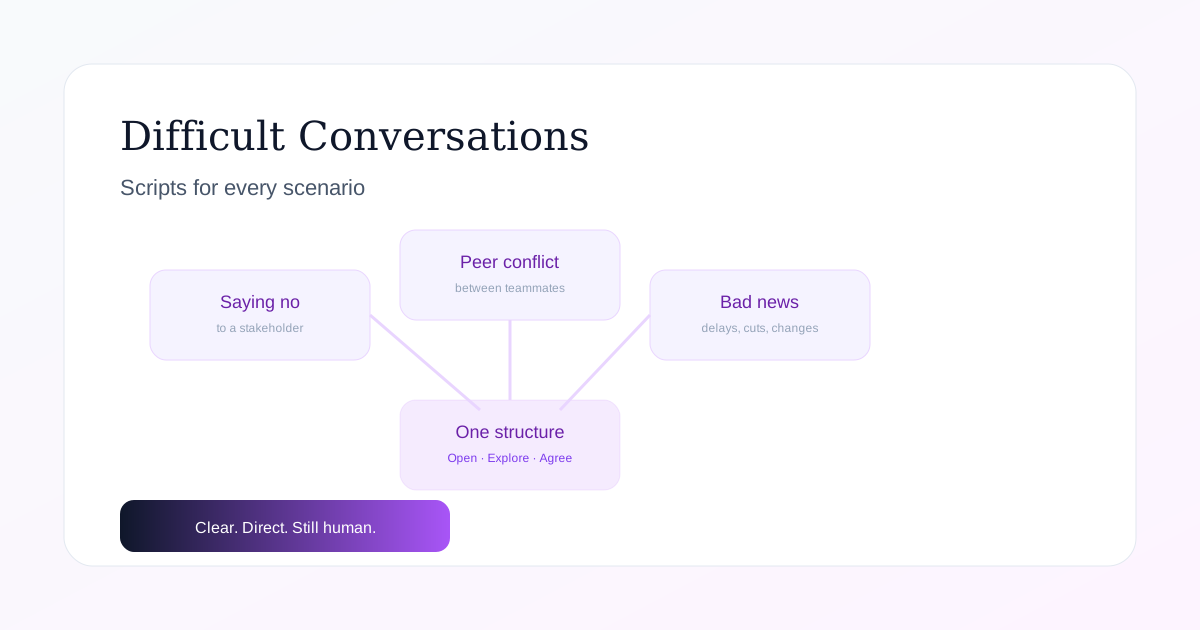
Telling a stakeholder no. Stepping into a conflict between two teammates. Delivering news nobody wants to hear. These conversations feel completely different from each other — but the reason they're all hard is the same: you're worried that being direct will damage the relationship.
The fix is not a script for every possible scenario. It's one reusable structure flexible enough to handle all of them, plus enough real examples that you're not starting from a blank page the next time one of these lands on your calendar.
One structure for every difficult conversation
- Open: state the topic plainly in one sentence, no preamble, no burying it in small talk.
- Explore: share what you observed and ask what they see — this is a conversation, not an announcement.
- Agree: land on a concrete next step, even a small one, before the conversation ends.
This works whether the conversation is two minutes or twenty. The structure doesn't change; only how much time you spend in "Explore" does.
A true story: the stakeholder conversation everyone was avoiding
A Product Owner (call her Merve) had a stakeholder repeatedly asking to add scope mid-sprint. Three sprints in a row, the team said yes, and three sprints in a row, they missed the sprint goal. Everyone complained about it privately. Nobody said anything to the stakeholder directly.
Merve finally opened with: "I want to talk about mid-sprint requests — we've said yes three times and missed our goal three times. I don't think that's working for either of us." No blame, just the pattern, stated plainly. The stakeholder hadn't connected the dots and agreed immediately to a same-day triage instead of same-day inclusion.
The conversation that felt like it would damage the relationship actually fixed the thing that was quietly damaging it already.
Script: saying no to a stakeholder
"I want to help with this, and I can't fit it into this sprint without risking what we already committed to. Here are two options: we swap it in for something else, or it's first in line next sprint. Which works better for you?"
This works because it's not a flat no — it's a no plus two real options, which keeps the stakeholder in control of the trade-off instead of feeling shut down.
Script: conflict between two teammates
"I've noticed some tension between you two in planning the last couple of sprints, and I want to understand what's going on before it affects the team. Can we talk — the three of us — about what's not working?"
Name the pattern, not a specific person's fault. Bring both people into the same room rather than triangulating through separate side conversations, which usually makes things worse, not better.
Script: delivering bad news
"I have an update that's not what we hoped for: [the news, stated plainly]. Here's what we know, here's what we're doing about it, and here's what I need from you."
Lead with the news, not a long wind-up. People can tell when bad news is coming from the tone before you say it — the wind-up just extends the anxiety without adding clarity.
🎯 Practice the version that doesn't go well: Mastery lets you run these exact scenarios — saying no, defusing conflict, delivering bad news — against a Socratic AI that pushes back like a real stakeholder would, so you're not improvising the hard part live for the first time. Try Mastery →
The mistakes that turn a hard conversation into a worse one
- Burying the point: ten minutes of context before the actual topic. Say the topic first, then give context if they ask.
- Doing it over chat: text strips tone, and difficult topics need tone. Voice or video first, written summary after.
- No proposed next step: ending on the problem instead of a next action leaves both people unsure what happens now.
- Rehearsing your part but not theirs: preparing what you'll say without thinking about how they'll likely respond means you freeze at the first pushback.
The Unseen Game: Trust, Rhythm, Purpose
A practical mini-book using a football-club metaphor to reveal the invisible system behind performance: trust, alignment, roles, and team rhythm.
English edition
When you need a coach in the room (and you don't have one)
Some conversations are high-stakes enough that you'd genuinely want a coach to help you prepare — a facilitation decision gone wrong, a conflict that's been simmering for months, a stakeholder relationship worth protecting.
🧭 Get a second opinion before the real conversation: Scrum Master Coach walks through complex, specific scenarios with you and gives feedback on your facilitation and framing choices before you're in the room for real. Try Scrum Master Coach →
FAQ
- What's the single most important thing to get right? Opening with the actual topic instead of burying it. Everything else is easier once the topic is on the table clearly.
- Should I write the conversation out beforehand? For high-stakes ones, yes — write your Open sentence word for word. You don't need to script the rest; the structure carries you.
- What if they get defensive or upset? Slow down, not down-shift into the topic. "I can see this is frustrating — I still want to figure this out together" acknowledges the reaction without abandoning the conversation.
- Async or live? Live (voice or video) for anything with emotional weight. Async is fine for the follow-up summary, never for the first delivery of hard news.
- How is this different from the SBI feedback model? SBI is specifically for behavior feedback. This structure (Open-Explore-Agree) is broader — it also covers conversations that aren't about someone's behavior at all, like saying no or delivering bad news.
This week's practice: pick one overdue conversation
Think of one difficult conversation you've been putting off. Write your Open sentence — one plain sentence stating the topic, no cushioning. Have the conversation this week using Open-Explore-Agree.
Most people report the same thing afterward: the anticipation was worse than the conversation itself. That gap — between how bad it feels to prepare for and how manageable it actually is — is the whole reason this skill is worth building deliberately instead of hoping it comes naturally under pressure.
Free PDF
Feedback Preparation Kit — Free PDF
3 fill-in templates: SBI preparation form, 7 pre-feedback checks, and 12 tough conversation openers.
- 1SBI preparation form
- 27 checklist questions
- 312 opening lines
No spam. Unsubscribe anytime.
Try the Related Tool
Practice difficult work moments with an AI character. Talk, get a star-based skill signal, and track growth.
Start exploring->Define sprint friction, form hypotheses, design an experiment, and run follow-up loops.
Open coach agent->The Unseen Game: Trust, Rhythm, Purpose
A practical mini-book using a football-club metaphor to reveal the invisible system behind performance: trust, alignment, roles, and team rhythm.
Who is it for?
Scrum Masters, Agile Coaches, Team Leads, Product/Engineering leaders
English edition