
Definition of Done: The Scrum Practice Most Teams Get Wrong
Most teams know what a Definition of Done is. Far fewer actually use one properly. Here's what it is, how to write one, and why it matters more than you think.
A sprint ended. Everyone said 'done.' The feature went live. Three hours later, a P1 bug came in. Tests hadn't been run. The deployment checklist was skipped. A manual step had been missed.
Nobody was cutting corners deliberately. They just had different ideas of what 'done' meant.
The Definition of Done exists to solve exactly this problem. And yet it remains one of the most underused practices in Scrum — known in theory, ignored in practice.
What Is the Definition of Done?
The Definition of Done (DoD) is a formal list of criteria that every Product Backlog Item (PBI) must meet before it can be considered complete.
The 2020 Scrum Guide defines it this way: 'The Definition of Done is a formal description of the state of the Increment when it meets the quality measures required for the product.'
Notice: not 'the developer merged their branch.' Not 'QA looked at it.' The word is releasable — meaning you could ship it to production right now if you chose to.
The DoD belongs to the whole team and applies to every story in the sprint. It's not written per-story — it's checked per-story.
- Formal: Agreed by the team, not interpreted individually
- Universal: Applies to every item in the sprint
- Measurable: 'Unit test coverage above 80%' not 'quality should be good'
- Living: Reviewed and updated in retrospectives as the team matures
Definition of Done vs. Acceptance Criteria
These two are the most commonly confused pair in Scrum. The distinction matters.
Acceptance Criteria: Story-specific. 'User receives a confirmation email after resetting their password.' Written by the Product Owner. Different for every story. Checked when that story is finished.
Definition of Done: Team-wide. 'Every code change must be peer-reviewed.' Written by the team together. The same for every story. Checked for every story.
The analogy: acceptance criteria answers 'how do you want this dish prepared?' The DoD answers 'what are our kitchen's hygiene and quality standards?'
- Acceptance Criteria: Per-story, written by PO, different each time
- Definition of Done: Team-wide, written together, same every time
- They complement each other — neither replaces the other
What Happens Without a DoD? The 'Undone Work' Trap
Teams without a Definition of Done fall into a predictable pattern.
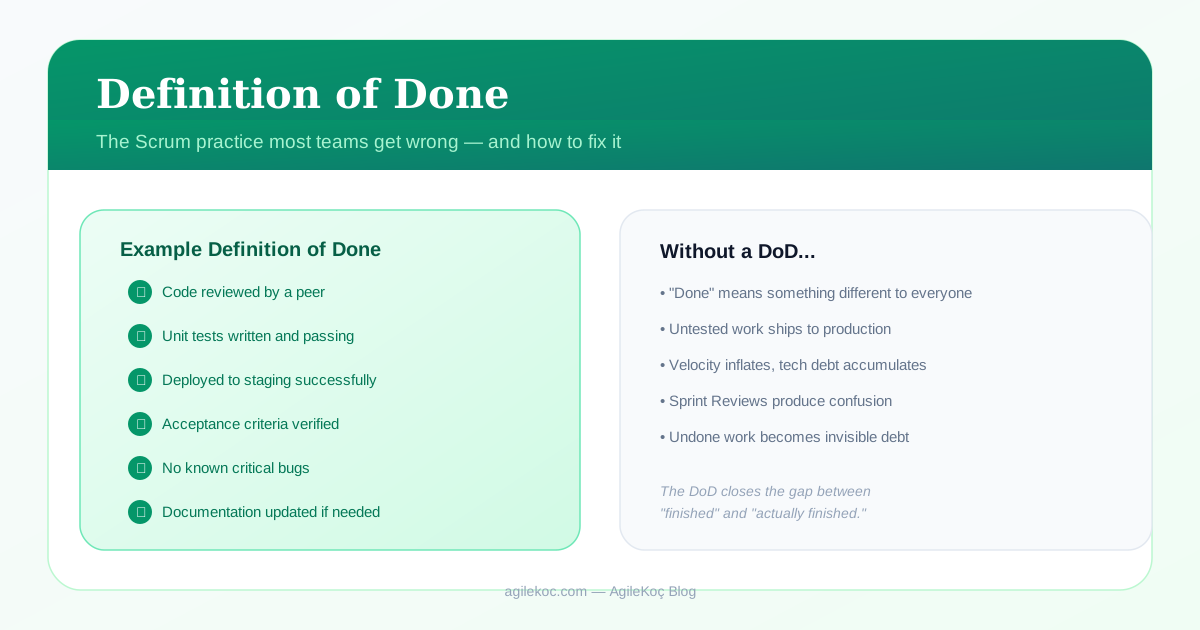
Stories get declared 'done' that aren't actually done. Velocity inflates because partially-finished work counts. A few sprints later, the question 'why are there so many bugs?' arrives.
The Scrum Guide calls this 'undone work' — invisible technical debt. It doesn't show up in the backlog. It doesn't get discussed in Sprint Review. But it ships to production, and it breaks things.
Undone work is the most dangerous kind of debt: you don't know how much you have.
What Does a Good Definition of Done Look Like?
Abstract entries are useless. 'Quality must be ensured' is not a DoD criterion — what does 'quality' mean? Every entry must be concrete and verifiable.
A practical example for a typical software team:
- Code written and peer-reviewed by at least one other developer
- All unit tests written and passing (target coverage: 80%)
- Integration tests run and passing
- Feature branch merged to main with no unresolved conflicts
- Application deployed successfully to staging environment
- Acceptance criteria verified by the team
- No known critical or high-priority bugs
- User documentation updated where applicable
This is a starting point. Adapt it to your team's tech stack, deployment process, and quality standards. A DoD that fits your team will always outperform a perfect DoD that nobody follows.
The Unseen Game: Trust, Rhythm, Purpose
A practical mini-book using a football-club metaphor to reveal the invisible system behind performance: trust, alignment, roles, and team rhythm.
English edition
How strong is your Scrum foundation? Test your understanding of Definition of Done, Sprint Review, and Scrum artifacts in about 10 minutes with the Scrum Quiz.
How to Create Your Definition of Done With the Team
The Scrum Master shouldn't write this alone. Neither should the Product Owner. This is a team output. A retrospective or dedicated workshop can follow this format:
- Step 1 — Ask the question: 'Which stories from the last 3 sprints finished later than expected or caused problems in production? What happened?'
- Step 2 — Find the root cause: Most of those incidents trace back to gaps in what 'done' meant. Build the list together.
- Step 3 — Draft the criteria: Every entry must be concrete and checkable. 'Be high quality' is not a criterion.
- Step 4 — Apply it in the next sprint: Check every story against the DoD. You'll slow down at first — that's expected and temporary.
- Step 5 — Review in retrospectives: The DoD is a living document. It should get sharper with every sprint.
Common Definition of Done Mistakes
1. No DoD exists: 'We all know what done means.' But everyone's definition is different. An unwritten rule is not a rule.
2. It exists but nobody checks it: The DoD is posted somewhere and never referenced in Sprint Review. Document exists, application doesn't. This is the most common scenario.
3. It's too long to be useful: A 40-item DoD gets ignored. Eight to twelve concrete items that everyone actually follows beats a comprehensive checklist that nobody uses.
4. It's written per-story: Writing a unique DoD for each story is both incorrect and inefficient. The DoD is team-wide — the same for every story.
5. It never gets updated: As the team grows and the product evolves, the DoD should evolve too. A DoD unchanged for a year is a DoD that stopped being inspected.
Definition of Done vs. Definition of Ready
These two are frequently confused. The difference is short and sharp:
Definition of Ready (DoR): Criteria a PBI must meet before the team can start working on it. Checked at Sprint Planning. 'Is this item ready to be pulled into a sprint?'
Definition of Done (DoD): Criteria a PBI must meet before it can be called complete. Checked at Sprint Review. 'Is this item truly done?'
- Definition of Ready: BEFORE the sprint starts — 'Is it ready to begin?'
- Definition of Done: BEFORE the sprint ends — 'Is it actually finished?'
- They complement each other and answer different questions
Want to run a DoD workshop with your team? Scrum Master Coach can help you plan the session, facilitate the conversation, and integrate your new DoD into your first sprint.
The Bottom Line
The Definition of Done is one of the least-discussed but highest-value tools in Scrum.
Teams focus on velocity, story points, and retrospective formats while the DoD quietly collects dust. But most of the quality problems, unexpected bugs, and 'why is there so much rework?' questions trace directly back to not having a clear, shared definition of done.
A good DoD gives you this: everyone on the same page about what finished means, no debates at Sprint Review, and technical debt that's visible and manageable instead of hidden and compounding.
If your team doesn't have a DoD yet, start in your next retrospective. You can begin with a single item. A working DoD with one criterion beats a perfect DoD that exists only as a slide deck.
Frequently Asked Questions
Does every team write their own DoD? Yes. Each team's tech stack, deployment pipeline, and quality standards are different. A general template can be a starting point, but the DoD must be owned and adapted by the team doing the work.
Can the Product Owner change the DoD? Not unilaterally. The DoD is created by the Developers. The PO can be involved in the conversation, but the decision belongs to the team.
Can the DoD change mid-sprint? No. Changing the DoD mid-sprint changes what 'done' means for work already in progress. Changes should wait until after the sprint retrospective.
What happens if a story doesn't meet the DoD? It's not done. It can't be shown in Sprint Review. It goes back to the Product Backlog for the next sprint.
How often should the DoD be updated? Review it every sprint retrospective. Change isn't mandatory, but the review is. As the team matures and the product grows, the DoD should grow with it.
Try the Related Tool
Define sprint friction, form hypotheses, design an experiment, and run follow-up loops.
Open coach agent->Make your Scrum Master impact visible + free PDF
Get short, practical tips each week. Your first email includes the “Scrum Master Impact Dashboard” PDF to help make your contribution visible.
SCRUM MASTER IMPACT DASHBOARD
30 Metrics + 6-Week Plan + Manager Conversation Guide
This document solves a common challenge for early/mid-level Scrum Masters: “How can my contribution be measured?” Without obsessing over velocity, without blame, you'll build a practical system focused on impact.
- Start in 10 minutes
- First results in 6 weeks
- Minimum set with 5 metrics
Golden rule: A Scrum Master doesn't “sell speed.” They improve learning and flow.
How to use this PDF
- 1) Pick 5 metrics today
- 2) Capture baseline (10 min)
- 3) Follow the 6-week plan
- 4) Update the dashboard each sprint
- 5) Talk to your manager with 3 sentences + 1 table
Minimum starter set
- Psychological safety
- WIP
- Sprint goal
- Unplanned work
- Blocker time
How do you prove your impact as a Scrum Master?
Without obsessing over velocity: 5 metrics + a 6-week plan for a clear impact story.
- 5-metric impact dashboard
- 6-week execution plan
- Manager-ready talk track
We respect your privacy. We only use your email to send the PDF and weekly tips.
No spam. Unsubscribe anytime.