
Are Story Points Worth It? The 2026 Case For and Against
An honest look at story points: what they're good for, where they break down, and how to decide if your team should keep using them.
I once watched a three-hour sprint planning where the team spent forty minutes debating whether a ticket was a 5 or an 8. The Scrum Master eventually called it: '8. Moving on.' Nobody asked what 'done' actually looked like. They just needed a number to put on the card.
Does that sound familiar? Story points have become one of the most debated practices in Agile development. In 2025 and 2026, experienced practitioners, tech leads, and entire organizations are asking the same question: 'Why are we doing this again?'
This article won't tell you to drop story points or keep them. It gives you an honest look at both sides so you can make an informed decision for your own team.
What Are Story Points? (And Why They Were Invented)
A story point is an abstract unit of estimation. It doesn't represent hours or days — it represents the relative size of a piece of work, combining complexity, uncertainty, and effort into a single number.
The approach was popularized by Kent Beck and Mike Cohn through XP and Scrum. Teams typically use a Fibonacci sequence (1, 2, 3, 5, 8, 13, 21...) where larger numbers signal both more work and more uncertainty.
The core logic is intuitive: humans are bad at estimating 'how many hours will this take?' but reasonably good at comparing: 'Is this bigger or smaller than that thing we finished last month?' Story points leverage relative judgment instead of absolute measurement.
- Complexity: How hard is the work technically or logically?
- Uncertainty: How clear is the scope and approach?
- Effort: How much raw work is actually involved?
- Risk: Are there unknowns, dependencies, or potential surprises?
What Is Velocity and Why Does It Matter?
Velocity is the average number of story points a team completes per sprint, calculated from past performance. If your team completed 34, 38, 36, and 40 points over four sprints, your velocity is roughly 37.
This number enables forecasting: divide your backlog's total points by velocity to estimate how many sprints a feature will take. '150 points at 37 per sprint ≈ 4 sprints.' Clean, simple, useful.
On paper, this is a powerful tool. In practice, it works well for some teams and breaks down badly for others. That gap is at the center of the 2026 story points debate.
The Case For Story Points
Before dismissing story points, it's worth taking their defenders seriously. The best arguments:
The question 'how many hours will this take?' is a trap. It links estimation directly to personal performance and creates anxiety. Story points abstract away that pressure — shifting the question from 'how fast are you?' to 'how big is this work?' That shift matters for team culture.
Planning Poker is genuinely valuable — not for the numbers it produces, but for what it reveals. When one developer plays a 2 and another plays a 13, those two people are thinking about completely different things. Surfacing that gap during planning prevents far bigger surprises later.
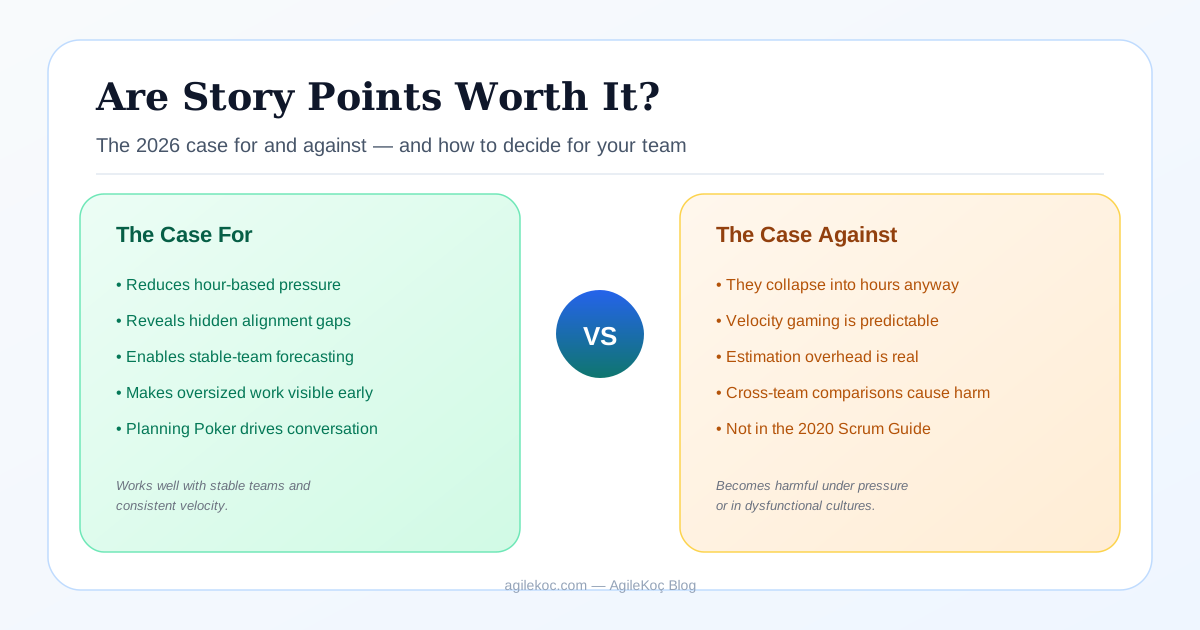
- Reduces hour-based pressure: Estimation stays relative, not tied to personal performance
- Reveals alignment gaps: Outlier estimates trigger conversations that prevent later surprises
- Enables stable-team forecasting: Consistent velocity makes planning more reliable
- Makes work size visible: A 40-point story is a clear signal it should be broken down
The #NoEstimates Movement and Why It's Growing
Around 2012–2013, Woody Zuill, Neil Killick, and Ron Jeffries started asking a pointed question: 'What if we just didn't estimate?' The movement was niche at first. By the mid-2020s, it had become a genuine mainstream conversation.
The core argument: estimation is a management tool, not a development tool. When someone asks 'when will this be done?', that question carries pressure. Under that pressure, teams don't produce honest estimates — they produce numbers designed to satisfy the people asking.
Allen Holub has taken this further, arguing against sprints and story points entirely. That position is controversial, but the underlying critique — that story points optimize for the appearance of predictability rather than real predictability — is difficult to fully dismiss.
Large-scale Agile implementations like SAFe have also spread velocity gaming: teams learn to inflate estimates to hit targets rather than improve actual throughput. That dynamic has added more fuel to an already heated debate.
The Strongest Arguments Against Story Points
Let's be direct about what story point critics get right:
- They collapse into hours: Managers develop conversions like '8 points = 2 days'. The abstraction disappears but the confusion stays
- Velocity gaming is predictable: Once tracked, teams inflate estimates to reduce pressure. Velocity rises without more work being done
- Estimation overhead is real: A 2-hour Planning Poker session for 6 tickets could have been spent actually discussing the work
- False precision: Debating a 5 vs. an 8 implies accuracy that doesn't exist — all estimates are ranges, not points
- Cross-team comparisons are harmful: Team A's 70 points vs Team B's 40 points tells you nothing except that they calibrate differently
The Unseen Game: Trust, Rhythm, Purpose
A practical mini-book using a football-club metaphor to reveal the invisible system behind performance: trust, alignment, roles, and team rhythm.
English edition
How solid is your Scrum foundation? Test your understanding of story points, velocity, and sprint planning in about 10 minutes with the Scrum Quiz — including questions on estimation and planning practices.
Where Story Points Actually Break Down: 5 Common Failure Modes
Story points don't fail because of the concept. They fail because of how they get used. Here are the five most common failure patterns:
1. Velocity becomes a performance metric: 'Last sprint you did 40 points, why only 37 this sprint?' Once a team hears that, estimates inflate. Next sprint is 50. Nothing actually changed except the numbers.
2. The Product Owner uses points to stuff sprints: 'We have 3 points of capacity left — let's add this card.' The question shifts from 'what's valuable?' to 'what fits the number?'
3. Planning Poker runs without real conversation: Everyone plays a 3, nobody asks questions, the ceremony is checked off. The actual value — shared understanding — never materializes.
4. Points convert to hours: Once '1 point = 4 hours' becomes the working assumption, you've abandoned story points and adopted a clunky time estimation system instead.
5. Teams get compared: 'Team A ships 60 points, Team B ships 40.' Different teams calibrate completely differently. This comparison is both meaningless and damaging.
What Works Instead of Story Points?
Several alternatives work well in practice, depending on your context:
- Story Counting: Every story = 1 unit. Plan by asking how many stories the team can finish. Works best when stories are consistently sized — itself a valuable discipline.
- T-Shirt Sizing: XS, S, M, L, XL. Relative sizing without numbers. Preserves the estimation conversation without creating the velocity trap.
- Flow Metrics (Cycle Time, Lead Time): Instead of predicting, measure. 'How long did similar work take historically?' uses real data instead of guesses.
- Just Ask: 'Will this fit in a sprint?' A binary answer forces useful scope conversations without the overhead of full estimation ceremonies.
The 2020 Scrum Guide quietly removed all references to story points and velocity. That wasn't an accident. The Scrum.org position is that these are optional practices — not core Scrum. Many teams have taken the hint.
Which Teams Should Drop Story Points?
Consider dropping story points if any of these apply to your team:
- Management uses velocity as a team or individual performance metric
- Velocity is compared across different teams
- Planning Poker debates consume more time than discussion about the actual work
- Developers have learned to inflate estimates to reduce pressure
- Points are being converted to hours, internally or externally
- 'How many points did we do?' matters more in retrospective than 'what did we learn?'
Which Teams Should Keep Story Points?
Story points remain a reasonable choice if:
- You're a new team and Planning Poker genuinely produces shared understanding
- Work size varies dramatically and sprint capacity visibility matters to you
- Velocity is stable (consistent over 4–6 sprints) and actually helps with forecasting
- Management treats velocity as a capacity signal, not a performance grade
- The team focuses on the conversation, not the number
Want help facilitating this conversation with your team? Whether you're thinking about dropping story points, switching systems, or just improving how you use them — Scrum Master Coach can help you plan the transition and facilitate the team discussion.
How to Decide: A Practical Framework
Theory aside, you need an actual decision. Here's what I'd suggest:
Start with the right question. Instead of 'should we use story points?', ask 'why are we using story points?' If the honest answer is 'that's just how we've always done it' or 'Scrum requires it' — note that the Scrum Guide makes no mention of story points — that's a signal to examine the practice more carefully.
Then check for symptoms. If you recognize multiple items from the 'drop story points' list above, try a one-sprint experiment without them. How did planning feel? Did conversations improve? Did pressure levels change?
There's a meaningful difference between continuing a practice because you've consciously chosen it and continuing it out of inertia. Both might lead to the same place — but only one keeps the team learning.
The Bottom Line
Story points are not a bad tool. They're a frequently misused one.
If your Planning Poker sessions generate real conversations, your velocity works as a low-pressure forecasting aid, and the team actually finds them useful — keep them. There's no need to change what's working.
But if 'how many points did we do?' has become more important than 'what are we building and why?', if estimates are inflating, or if velocity is being used to benchmark performance — that's not a story points problem. That's a culture and process problem.
Culture problems don't get solved by changing estimation systems. But sometimes changing the estimation system is the right catalyst to start that harder conversation.
Frequently Asked Questions
What's the difference between story points and hours? Hours are absolute — 60 minutes. Story points are relative — 'roughly this big compared to that.' They answer different questions and should never be directly converted into each other.
What is Planning Poker? A technique where everyone reveals their estimate simultaneously, preventing anchoring bias. Divergent estimates are the most valuable outcome — they start the right conversations.
Why does velocity fluctuate sprint to sprint? Illness, holidays, technical debt, dependencies, and estimation variance all affect velocity. That's normal and expected. The problem is trying to force velocity to stay constant through pressure — that just produces inflated estimates.
Should the Product Owner estimate story points? Most Scrum coaches say no. The PO's business perspective can unintentionally anchor or bias technical estimates. The people doing the work generally have better judgment about technical size.
How do you measure velocity without story points? Story count, throughput (items completed per sprint), or cycle time all work as alternatives. Consistency matters more than the specific metric — measure the same thing the same way and trends will emerge.
Try the Related Tool
Define sprint friction, form hypotheses, design an experiment, and run follow-up loops.
Open coach agent->Make your Scrum Master impact visible + free PDF
Get short, practical tips each week. Your first email includes the “Scrum Master Impact Dashboard” PDF to help make your contribution visible.
SCRUM MASTER IMPACT DASHBOARD
30 Metrics + 6-Week Plan + Manager Conversation Guide
This document solves a common challenge for early/mid-level Scrum Masters: “How can my contribution be measured?” Without obsessing over velocity, without blame, you'll build a practical system focused on impact.
- Start in 10 minutes
- First results in 6 weeks
- Minimum set with 5 metrics
Golden rule: A Scrum Master doesn't “sell speed.” They improve learning and flow.
How to use this PDF
- 1) Pick 5 metrics today
- 2) Capture baseline (10 min)
- 3) Follow the 6-week plan
- 4) Update the dashboard each sprint
- 5) Talk to your manager with 3 sentences + 1 table
Minimum starter set
- Psychological safety
- WIP
- Sprint goal
- Unplanned work
- Blocker time
How do you prove your impact as a Scrum Master?
Without obsessing over velocity: 5 metrics + a 6-week plan for a clear impact story.
- 5-metric impact dashboard
- 6-week execution plan
- Manager-ready talk track
We respect your privacy. We only use your email to send the PDF and weekly tips.
No spam. Unsubscribe anytime.