
AI Is No Longer Just Answering: Agentic Workflows for Modern Teams
AI agents are moving from one-off answers to repeatable team workflows. A practical, human guide with real stories, meeting examples, risks, and adoption steps for 2026.
A familiar Monday story
A product lead I know used to begin every Monday the same way. First, she would open notes from last week's review. Then she would pull highlights from Slack. Then she would listen back to the part of the stakeholder call where the decision changed. Then she would rewrite three action items into something the team could actually use.
None of that work was strategic. None of it was especially hard. But it quietly consumed the first hour of her week. By the time the team started planning, she was already tired from reconstructing context that had existed only a few days earlier.
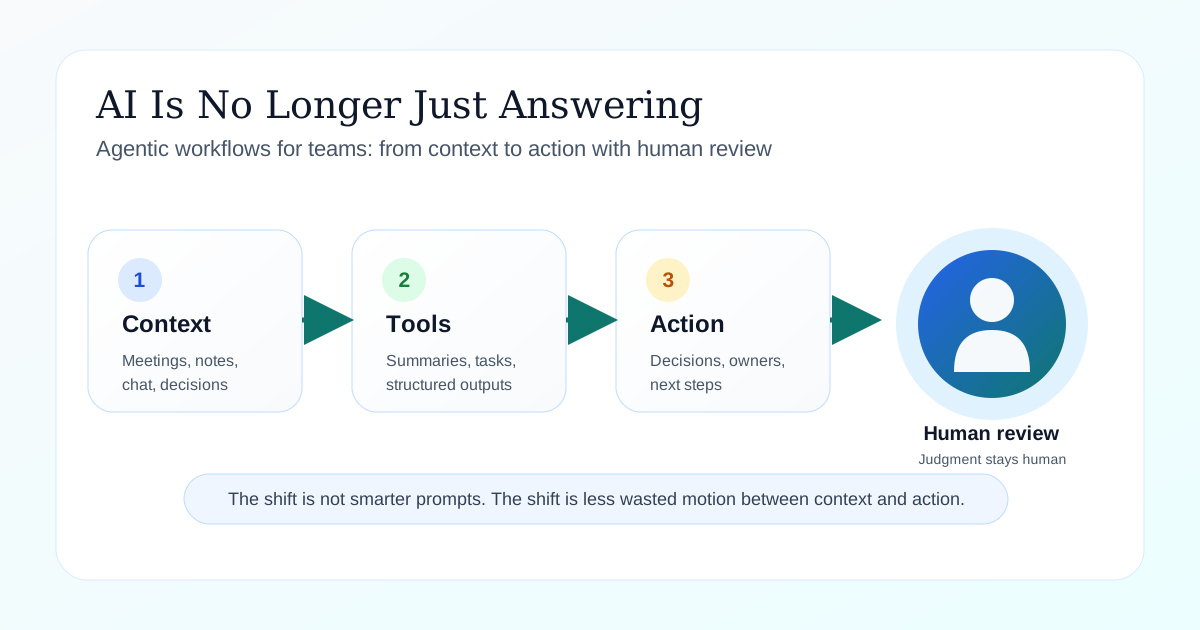
That is the reason the phrase agentic workflow matters right now. The shift is not only that AI can write a better answer. The shift is that AI can now help a team move through a small chain of work: collect context, organize it, produce a usable output, and tee up the next step for a human to review.
What changed in 2026?
For a while, workplace AI mostly meant prompt-in, answer-out. Ask for a summary. Ask for a draft. Ask for five ideas. Useful, but shallow. The newer pattern is different. Teams are starting to expect AI to work across steps, not just within one response.
This spring, that expectation became much more visible. The major platforms all started talking less about clever one-shot responses and more about tools, memory, context, tasks, and handoffs. In other words: fewer demos about sounding smart, more demos about helping work move.
That does not mean every team suddenly needs an army of agents. It means the practical bar has changed. People are no longer asking only, "Can AI answer this?" They are asking, "Can AI help carry this from messy input to usable next action?"
So what is an agentic workflow, in plain English?
A simple definition works best: an agentic workflow is a repeatable piece of work where AI does more than generate text once. It follows a small path.
Usually that path looks like this:
- it receives context from one or more places,
- it applies a clear goal or rule,
- it produces a structured output,
- it optionally uses a tool or system,
- and it leaves a human with a cleaner decision than they had before.
Which team work is actually a good fit?
Not every problem deserves an agent. Teams get the most value when the work is repetitive, multi-step, and mildly annoying rather than deeply ambiguous.
Good candidates usually share four traits:
- the same information has to be cleaned or reorganized again and again,
- the workflow spans more than one surface such as meetings, notes, chat, or task tracking,
- there is a clear shape to the output,
- and a human still needs to approve the final move.
Example 1: from meeting noise to visible action
This is one of the clearest starting points. Teams do not usually suffer because meetings produce zero value. They suffer because the value leaks out afterward. Decisions blur. Action items disappear. Someone who missed the call asks for a recap, and the same synthesis work happens twice.
An agentic workflow can reduce that leak. Instead of treating the meeting as a recording archive, the workflow turns it into a usable layer: transcript, summary, decisions, action items, and a cleaner handoff.
That is the difference between AI as a clever note taker and AI as an actual workflow component.
A practical example: Meeting Assistant helps teams turn a recording into a transcript, AI summary, and visible action items so the useful residue of the meeting is easier to review and reuse.
Example 2: from vague team problem to a real experiment
A lot of team pain starts as a sentence that feels true but is still too fuzzy to act on: "Our dailies feel flat." "Retros are not changing anything." "We keep talking, but not actually moving."
This is where human judgment still matters most. But it is also where AI can help structure the first pass. A good agentic workflow can turn a messy observation into possible hypotheses, follow-up questions, and small experiments worth testing.
That matters because many teams are not blocked by lack of insight. They are blocked by lack of momentum between the insight and the next deliberate experiment.
Another useful layer: Scrum Master Coach is designed for exactly this kind of follow-through: turning a blurry team issue into hypotheses, experiment ideas, and check-in loops instead of leaving it as hallway frustration.
Where teams get this wrong
The mistakes are surprisingly consistent. Teams often try to use agents for work that is politically unclear rather than operationally repetitive.
That usually creates polished confusion instead of progress.
- Bad fit 1: using AI to settle an unresolved decision-rights problem.
- Bad fit 2: treating a clean summary as if it were automatically correct.
- Bad fit 3: letting the workflow touch sensitive information without clear permission boundaries.
- Bad fit 4: automating a bad process instead of removing unnecessary steps first.
A small adoption plan that does not create theater
If you want to test agentic workflows without turning it into an internal innovation performance, start with one narrow loop for one week.
- Step 1: pick one repeatable team task that already happens every week.
- Step 2: define the exact input and the exact output you want.
- Step 3: keep human review explicit; do not hide it.
- Step 4: measure one real effect: time saved, clarity gained, or fewer dropped actions.
- Step 5: only expand once the first loop is genuinely useful.
What should stay human?
The fastest way to get confused about AI agents is to forget that work has layers. Context gathering can often be automated. Interpretation can sometimes be accelerated. Accountability cannot be outsourced.
People should still own:
- judgment in ambiguous situations,
- sensitive decisions involving trust or tradeoffs,
- the meaning of success,
- and the final decision to act.
Conclusion: the real shift is not smarter answers, but less wasted motion
The most important thing about agentic workflows is not that they look futuristic. It is that they remove avoidable drag from ordinary team work.
The product lead from the beginning of this article still reviews decisions herself. She still chooses what matters. But she no longer spends the first hour of the week rebuilding context by hand. That change is small enough to sound boring and meaningful enough to compound.
That is the real promise here. AI is no longer only answering. Used well, it starts to carry some of the low-leverage motion between context and action so teams can spend more time on the work that actually needs them.
Frequently asked questions
What is an agentic workflow?
A repeatable workflow where AI helps across multiple steps such as collecting context, organizing information, and preparing a usable next action rather than only generating one response.
Are agentic workflows the same as AI agents?
Not exactly. AI agents are one implementation pattern. Agentic workflows describe the broader work shape: goal, context, tools, output, and human review.
What is the best first use case for a team?
Meeting follow-through is usually the cleanest start because the inputs and outputs are familiar, repetitive, and easy to validate.
Will this replace managers, Scrum Masters, or team leads?
No. It can reduce repeated coordination work, but trust, judgment, and accountability stay human.
Try the Related Tool
Upload or record audio or video — AI identifies the content type, summarizes it, and gives you tailored recommendations. Meetings, lectures, conversations, interviews, voice notes.
Recording tool->Define sprint friction, form hypotheses, design an experiment, and run follow-up loops.
Open coach agent->Make your Scrum Master impact visible + free PDF
Get short, practical tips each week. Your first email includes the “Scrum Master Impact Dashboard” PDF to help make your contribution visible.
SCRUM MASTER IMPACT DASHBOARD
30 Metrics + 6-Week Plan + Manager Conversation Guide
This document solves a common challenge for early/mid-level Scrum Masters: “How can my contribution be measured?” Without obsessing over velocity, without blame, you'll build a practical system focused on impact.
- Start in 10 minutes
- First results in 6 weeks
- Minimum set with 5 metrics
Golden rule: A Scrum Master doesn't “sell speed.” They improve learning and flow.
How to use this PDF
- 1) Pick 5 metrics today
- 2) Capture baseline (10 min)
- 3) Follow the 6-week plan
- 4) Update the dashboard each sprint
- 5) Talk to your manager with 3 sentences + 1 table
Minimum starter set
- Psychological safety
- WIP
- Sprint goal
- Unplanned work
- Blocker time
How do you prove your impact as a Scrum Master?
Without obsessing over velocity: 5 metrics + a 6-week plan for a clear impact story.
- 5-metric impact dashboard
- 6-week execution plan
- Manager-ready talk track
We respect your privacy. We only use your email to send the PDF and weekly tips.
No spam. Unsubscribe anytime.