 AgileKoc Tools
What Is Agentic Agility? How AI Agents Can Change the Scrum Master’s Work
What do AI agents actually add to Agile transformation? A practical guide to where they can help Scrum Masters with preparation, visibility, follow-through, and learning loops.
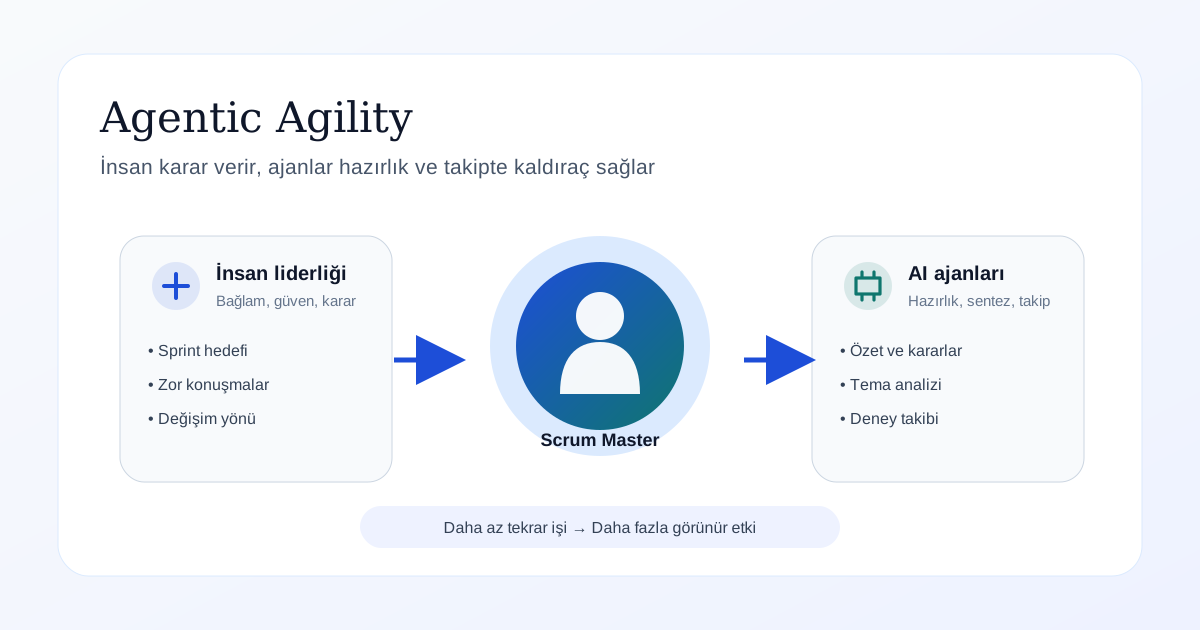
What is agentic agility?
The first wave of workplace AI mostly helped people create things: summaries, drafts, ideas, translations. The newer wave is different. AI agents are designed to pursue a goal across multiple steps, use tools, gather information, and help move work forward rather than only answer a prompt.
In Agile environments, a useful way to think about this is agentic agility: people keep ownership of judgment, trust, and direction, while agents take on more of the preparation, synthesis, and follow-through work that quietly consumes time around the edges of delivery.
This is not a story about replacing Scrum Masters. It is a story about asking a better question: how much of a Scrum Master’s week is spent on coaching, facilitation, and improving the system—and how much is spent cleaning notes, chasing actions, reformatting the same information, or reconstructing what happened across meetings?
Agentic agility matters because it can reduce the second bucket without weakening the first.
First, the boundary: an AI agent is not a Scrum Master
A Scrum Master is accountable for helping the team and the organization understand and apply Scrum, improve effectiveness, and create the conditions for better learning. That work is relational and contextual.
An agent can summarize a meeting. It cannot fully know why the room went quiet after one person spoke, which old conflict is hiding underneath a polite disagreement, or whether a team needs challenge, protection, or simply more clarity in that moment.
So the useful question is not, “Will agents replace Scrum Masters?” It is:
“Which parts of the work should stay deeply human, and which parts can be accelerated so humans have more room to do them well?”
Where agents are strongest: the invisible work around the work
Agile teams depend on a lot of valuable but often invisible labor:
- turning discussion into visible decisions,
- spotting whether the same issue keeps returning across Sprints,
- organizing feedback into themes,
- keeping experiments and action items from disappearing,
- making the next useful conversation easier to have.
None of this is glamorous. Yet when it is missing, teams become foggy. Agents are promising here because these tasks are information-heavy, repetitive, and benefit from consistent follow-through.
1. Turn meetings into usable signal faster
Many meetings end with the hard work still ahead: What exactly did we decide? What remains open? Who owns the next move? Which feedback actually changes product direction?
Scrum Masters often pay the tax twice—first by facilitating the room, then by reconstructing the room afterward.
Agents can help at three levels:
- produce transcripts,
- extract decisions and action items,
- surface recurring topics across multiple conversations.
That does not make the meeting automatically valuable. But it does make the useful residue of the meeting easier to capture.
📝 Example: Meeting Assistant turns a recording into a transcript, summary, decisions, and action items so the Scrum Master can stay present in the conversation instead of acting like the meeting secretary.
2. Move from vague concern to structured experimentation
A large part of Scrum Master work begins before the problem has a clean name.
You hear things like:
- “Daily Scrum keeps dragging.”
- “Retro actions never really stick.”
- “The team feels quieter than usual.”
- “We are busy, but not moving.”
An agent should not pretend to diagnose the team for you. But it can help structure the ambiguity: suggest possible hypotheses, propose small experiments, prepare follow-up prompts, and help track whether the intervention is actually being tested.
🧭 Example: Scrum Master Coach Agent helps turn a messy team issue into hypotheses, experiment plans, and check-in loops—so you can move faster from “something feels off” to “what will we test next?”
3. Make transformation learning less lossy
One of the quiet failures in Agile transformation is that learning gets lost.
A team runs a useful experiment, another team repeats the same mistake six weeks later. A retrospective identifies an important dependency pattern, but the insight disappears into a board screenshot. A leader asks for progress, and the organization rebuilds the story from scratch every time.
Agents can help create better organizational memory by:
- keeping experiment histories accessible,
- connecting recurring themes across teams,
- summarizing progress without burying people in raw notes,
- making useful knowledge easier to retrieve when a similar problem returns.
That is not bureaucracy. It is preserving learning. Agile is not only about responding quickly; it is also about not relearning the same lesson forever.
4. Help Scrum Masters spend less time proving work happened
A strange amount of modern knowledge work is spent proving that work happened: compiling updates, cleaning summaries, restating decisions, forwarding context, and packaging the same information for different audiences.
When agents reduce that burden, the value is not only time saved. The larger gain is that Scrum Masters can spend more energy where their leverage is highest:
- improving facilitation quality,
- noticing system constraints,
- having the hard conversation earlier,
- designing better experiments,
- protecting the team’s ability to learn.
The risks are real
Agentic agility can easily slide into bad practice if teams treat polished output as truth.
At least four risks deserve attention:
- Context loss: the agent sees the text, not the full history of trust and conflict behind it.
- False certainty: a clean summary can still be a weak interpretation.
- Privacy: meeting recordings, feedback, and employee signals are sensitive data.
- Responsibility drift: agents can recommend; humans remain accountable for judgment.
The goal is not to automate humanity out of Agile work. The goal is to reduce avoidable drag around the work so human judgment is used where it matters most.
A practical map: what should agents do, and what should stay human?
A simple split helps:
- Good agent tasks: summarization, classification, first drafts, reminders, pattern extraction, trend tracking.
- Human tasks: trust-building, conflict navigation, ethical judgment, facilitation choices, role modeling, and deciding what actually matters now.
Put differently: agents should not do the coaching for you. They should help clear enough noise that you can coach better.
Three realistic scenarios
1. The overloaded meeting week: A Scrum Master attends eight or ten conversations in a week and spends extra hours turning them into notes and follow-ups. With meeting synthesis handled more systematically, that time can shift toward retro preparation and stakeholder alignment.
2. The recurring but blurry issue: A team keeps saying “we need better ownership,” but the symptoms are inconsistent. An agent-supported coaching flow helps break the phrase into hypotheses: unclear decision rights, too much WIP, or missing review moments.
3. The transformation with weak memory: Several teams run local improvements, but insights stay local. Better capture and retrieval make it easier to notice repeated patterns and reuse learning instead of starting from zero every month.
Will agentic agility speed up Agile transformation?
Not by itself.
Poor leadership, weak product direction, and low trust do not disappear because the summaries got better.
But in a healthy system, agents can accelerate three things that matter a lot:
- visibility,
- learning loops,
- follow-through.
That is not a small contribution. Many transformations stall not because nobody knows what to do, but because information is scattered, learning arrives late, and actions quietly evaporate.
The future Scrum Master should be less busy and more useful
The most compelling promise of agentic agility is not an autonomous Agile machine. It is a better allocation of human attention.
The future Scrum Master should spend less time reformatting evidence that work occurred and more time asking better questions, designing sharper experiments, enabling tougher conversations, and helping teams learn faster.
AI agents can shorten that path. Humans still choose the direction.
Frequently asked questions
Is agentic agility just Agile with AI?
Not exactly. It is better understood as using agents to support repeatable knowledge work around Agile delivery while keeping human judgment at the center.
Can AI agents replace Scrum Masters?
They can accelerate summaries, first-pass analysis, and follow-up structures. They do not replace trust-building, facilitation judgment, or context-sensitive intervention.
Where do agents add the most value in Agile work?
Meeting synthesis, experiment tracking, visibility across recurring patterns, and preserving learning that would otherwise get lost.
Where should a team start?
With low-risk, repeatable workflows: meeting summaries, action tracking, or structured coaching preparation—not with automating sensitive decisions.
Try the Related Tool
Transcribes a meeting recording, generates a concise summary, and answers your questions.
Meeting tool->Define sprint friction, form hypotheses, design an experiment, and run follow-up loops.
Open coach agent->The Unseen Game: Trust, Rhythm, Purpose
A practical mini-book using a football-club metaphor to reveal the invisible system behind performance: trust, alignment, roles, and team rhythm.
Who is it for?
Scrum Masters, Agile Coaches, Team Leads, Product/Engineering leaders
English edition
Make your Scrum Master impact visible + free PDF
Get short, practical tips each week. Your first email includes the “Scrum Master Impact Dashboard” PDF to help make your contribution visible.
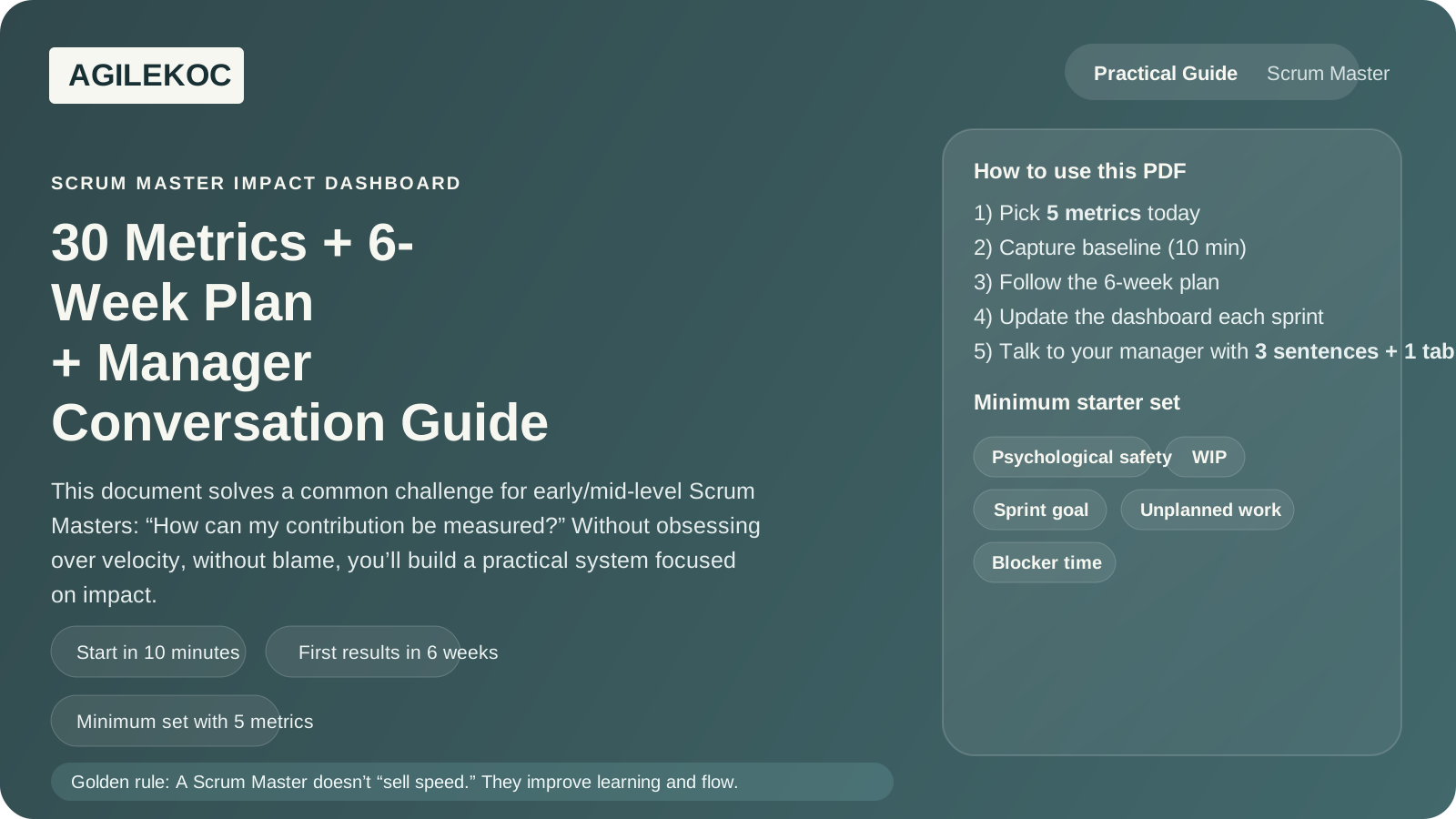
How do you prove your impact as a Scrum Master?
Without obsessing over velocity: 5 metrics + a 6-week plan for a clear impact story.
- 5-metric impact dashboard
- 6-week execution plan
- Manager-ready talk track
We respect your privacy. We only use your email to send the PDF and weekly tips.
No spam. Unsubscribe anytime.